
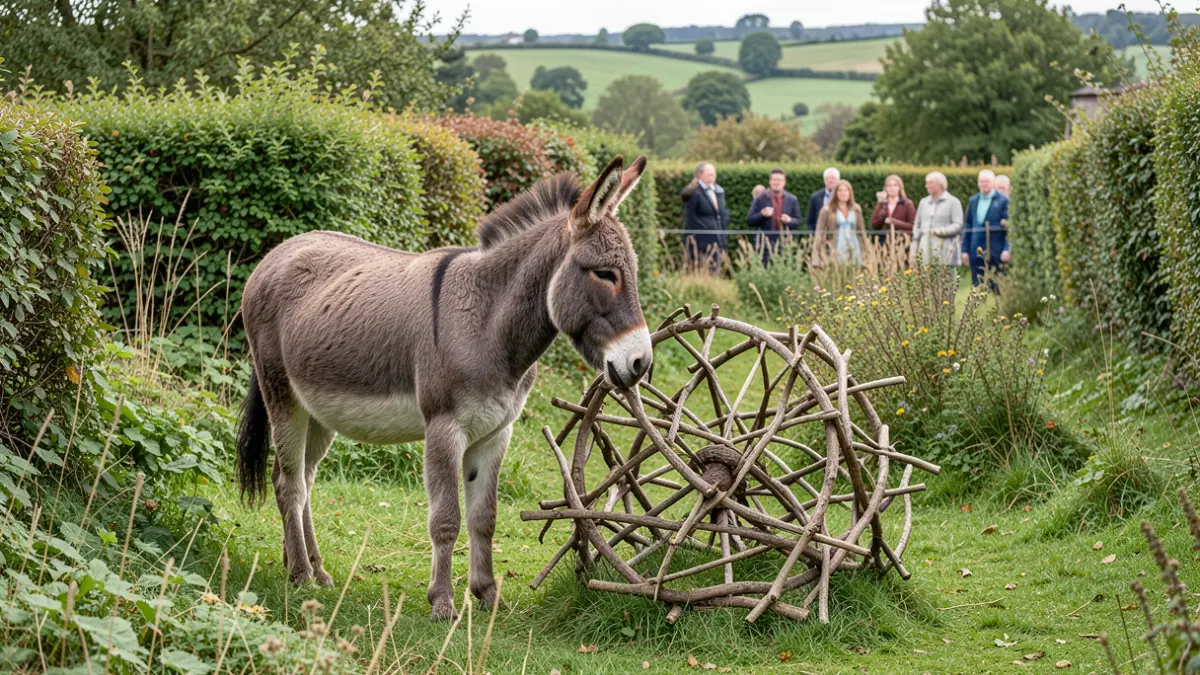
The study, jointly funded by The Donkey Sanctuary and the university, explored how donkeys at the charity’s Sidmouth site interact with native hedgerow species. PhD researcher Jessie Fitts found that donkeys demonstrated clear preferences for feeding on leaves, twigs, shrubs, and woody plants, readily incorporating them into their diet. This highlights the value of offering browsing opportunities alongside traditional grazing.
Findings support the use of innovative browsing structures, known as 'whirligigs', which feature donkey-safe branches like hazel and willow, often enhanced with herbs. These structures, introduced across The Donkey Sanctuary's sites, provide foliage variety, browsing opportunities, and crucial mental stimulation. Enrichment is considered vital for donkey care, helping to prevent boredom, encourage physical activity, manage weight, and support overall welfare.
Paddock redesigns for resident miniature donkeys have included the addition of tracks, earth mounds, and diverse grass and wildflower mixes, alongside new trees to create sheltered areas and provide privacy. Researchers are building a stronger evidence base for enrichment and welfare by monitoring donkey interactions with their environment.
“"Our research explores how more diverse environments impact both donkeys and the land. Across three studies, we have found that fields of greater habitat variety improve donkey welfare. Browsing specifically is an important part of their diet and providing access to hedgerow species allows donkeys to carry out species-specific behaviours. We hope to offer an evidence base for donkey husbandry and land management, so owners and keepers can take advantage of the mutual benefit between a mix and variety of habitat and donkey welfare."
Hannah Bryer, Head of Welfare at The Donkey Sanctuary, emphasised the charity's continuous exploration of practical methods to create environments that allow donkeys to express a broader range of natural behaviours and have greater autonomy. She noted that monitoring donkey behaviour helps in understanding improvements and tailoring enrichment to their needs. The benefits extend globally, aiding donkey owners worldwide.
Bryer added that enrichment also benefits caregivers, with the ability to see donkeys explore, browse, and make choices being rewarding for everyone involved. She expressed pride in leading the way in donkey welfare advancements. The Donkey Sanctuary aims for its research to inform future best practices, supporting donkeys' physical, behavioural, and emotional well-being.